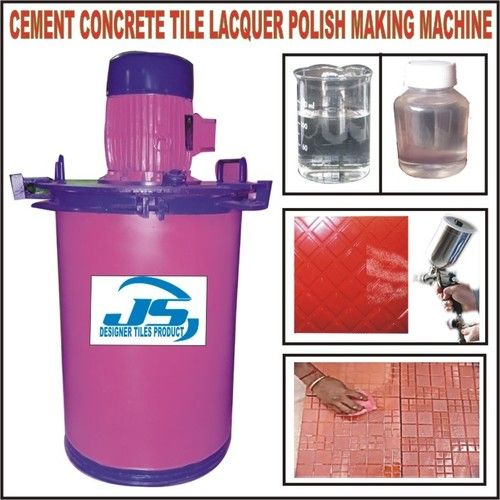
Cement Concrete Tile Lacquer polish making machine About
Js designer tiles product is a manufacturer of Cement Concrete Tile Lacquer Polish making machine and also providing of consultancy of making lacquer polish which is also called Shiner, Coating etc. Our technical teams keep on research of latest technology of lacquer polish making process. We provide a proper formulation of making lacquer polish with live telecast production by machinery. And also provide a test report of lacquer polish. Our lacquer polish provide high gloss and fully water proof of your pavers and heat reflection of sun lighting.
Specification Of Hardener Machine
1. Capacity of machine :- 200.kg to 500.kg
2. Power :- 2hp , 3hp , 5hp, and 3 phase
3. Weight of machine :- 100.kg to 200.kg
4. Body quality :- SS
Specification Of Lacquer Polish & Shiner
1. High glossy
2. Heat Resistance Of Sun Lightning
3. Fully Water Proofing
4. Long Life
5. Quick Dry After Apply
6. Excellent Weather ability
7. Coverage Area in one liter 60 to 65. Sqr.ft
8. Spray and Sponge both Production Process
Reliable Performance for Industrial DemandsThis semi-automatic machine provides consistent and high-quality lacquer polish for cement concrete tiles, supporting industrial requirements with batch capacities between 150 and 300 liters. Built with steel and weighing 100-200 kg, its robust structure ensures longevity and stability even under frequent use.
Precision Engineering and Long LifespanDesigned with a tolerance of 0.01 mm and capable of handling single or multiple cavities, the machine assures accurate shaping and optimal polish application. Its mould life reaches up to 100,000 cycles and the equipment itself serves effectively for 10-12 years, providing cost efficiency over time.
User-Friendly Operation and SafetyPowered by 2-3 HP and operating on standard voltage requirements, the machine is easy to install and run within industrial settings. The semi-automatic operation simplifies control and maintenance, ensuring operators can efficiently manage output while prioritizing safety.
FAQs of Cement Concrete Tile Lacquer polish making machine:
Q: How does the Cement Concrete Tile Lacquer Polish Making Machine operate?
A: This machine operates on a semi-automatic process, using mechanical components to mix and apply lacquer polish to concrete tiles. Its steel mold base and precise shaping mode ensure consistent results with minimal manual intervention.
Q: What is the batch capacity and mold life of this equipment?
A: Each batch ranges from 150 to 300 liters, making it suited for medium to large-scale industrial use. The molds used in this machine feature a life of up to 100,000 cycles, accommodating frequent production cycles without compromising quality.
Q: When should maintenance be performed on the machine?
A: Regular maintenance is recommended every few months depending on usage intensity. Routine checks on critical components, mold base condition, and lubrication ensure optimal performance and extend the lifespan up to 10-12 years.
Q: Where can this machine be installed for best results?
A: The machine is ideally suited to industrial environments such as tile manufacturing units. It requires a power supply of 220-240 V and can be integrated seamlessly into various production lines across India.
Q: What is the process of making lacquer polish using this machine?
A: The process involves loading raw materials into the steel mixing chamber, which is then operated in semi-automatic mode. The machine ensures even lacquer distribution and precision molding, producing polished concrete tiles efficiently.
Q: How is the benefit of polished surface ensured?
A: Thanks to the robust mechanical shaping, high-quality steel molds, and precise tolerance levels, the machine delivers a consistently polished finish on every tile batch, elevating the aesthetic and durability of finished concrete tiles for industrial applications.
Q: Can different shapes and cavity options be used?
A: Yes, the machine supports both single and multiple cavity modes, allowing operators to create various tile shapes according to production needs. The shaping mode is mechanical, ensuring adaptability and flexibility in manufacturing.


 Send Inquiry



 Send Inquiry
 Send Inquiry
 Send SMS
 Call Me Free
